
Identifying Small Mean Reverting Portfolios
Generalizes pairs trading to n assets: finds the most mean-reverting portfolio using at most k of them, via a cardinality-constrained generalized eigenvalue problem solved by greedy search or semidefinite relaxation.
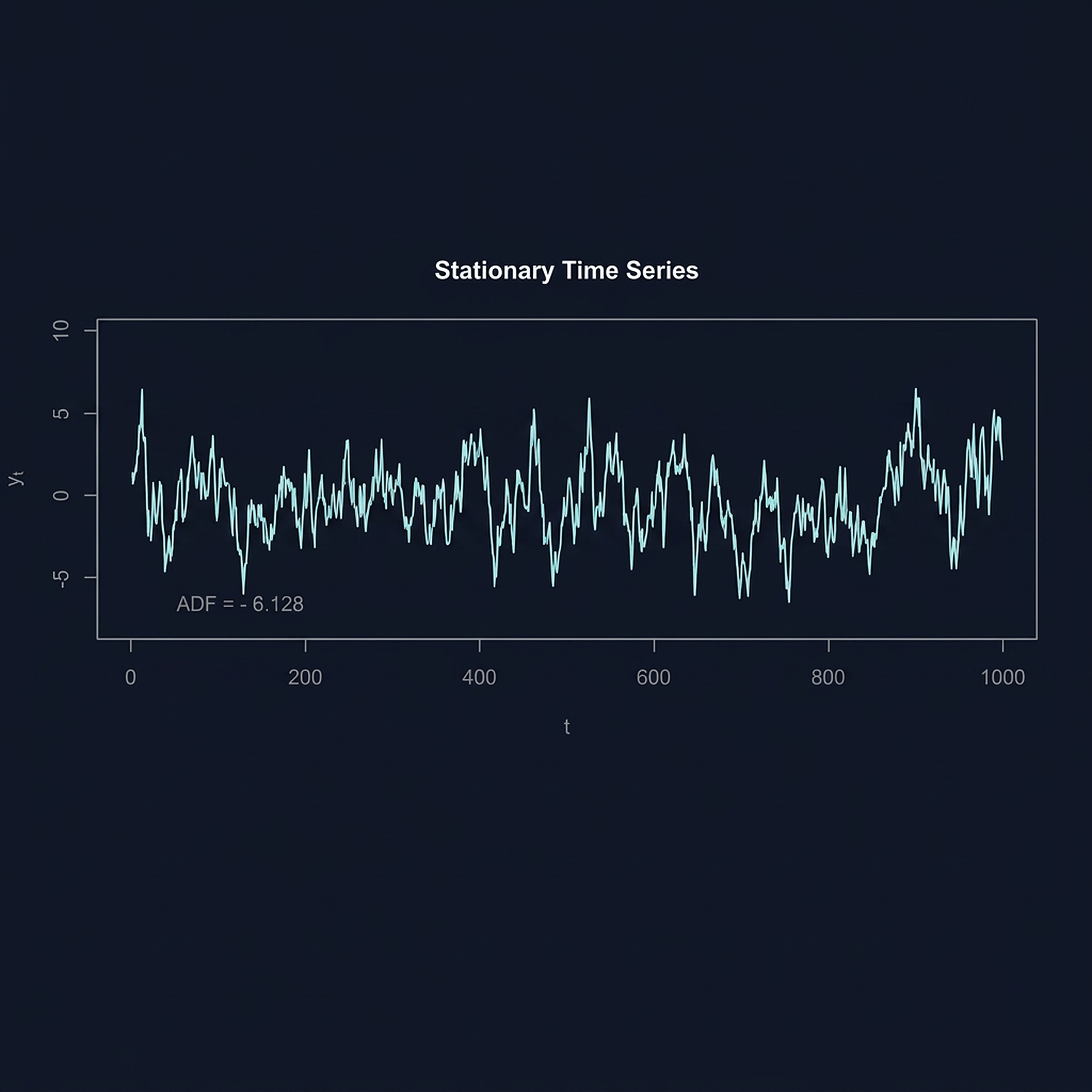
Classic cointegration and canonical-correlation methods produce mean-reverting portfolios that hold every asset: expensive to trade, hard to interpret, and often so noisy they vary inside the bid-ask spread. d'Aspremont instead asks for the most mean-reverting portfolio that uses only a handful of assets.
The portfolio value is modelled as an Ornstein-Uhlenbeck process, and the Box-Tiao predictability ratio xᵀAᵀΓAx / xᵀΓx serves as a tractable proxy for the mean-reversion speed λ. Minimizing it is a generalized eigenvalue problem; adding the sparsity constraint card(x) ≤ k makes it NP-hard.
Two solvers are provided: a greedy search that adds one asset at a time, and a semidefinite relaxation that lifts the problem to a matrix variable — the latter also certifies how far the greedy solution is from optimal. ℓ1-penalized covariance and VAR estimation stabilize the inputs in high dimensions.
On U.S. swap rates the most mean-reverting canonical portfolio has a half-life of about one day, and the sparsity-versus-predictability tradeoff is very favorable: sparse portfolios keep most of the mean reversion while trading in a wider, economically meaningful price range. The paper also links the estimated λ directly to optimal position sizing and leverage bounds for convergence trading.
References
- d'Aspremont, A. (2011). "Identifying Small Mean-Reverting Portfolios." Quantitative Finance, 11(3), 351–364. https://www.di.ens.fr/~aspremon/meanrev.html
- Preprint: https://arxiv.org/abs/0708.3048