
Infantino's PCA Model
A high-frequency stat-arb model: rolling PCA on a liquid stock universe builds a factor-hedged fair-value signal, and a dispersion-based regime switch decides whether to fade the move or follow it.
Motivated by the Fundamental Law of Active Management — at second-to-minute holding periods across many names, breadth is so large that even a tiny predictive edge compounds into a competitive information ratio — the model trades 50 liquid S&P 500 stocks on one-second data.
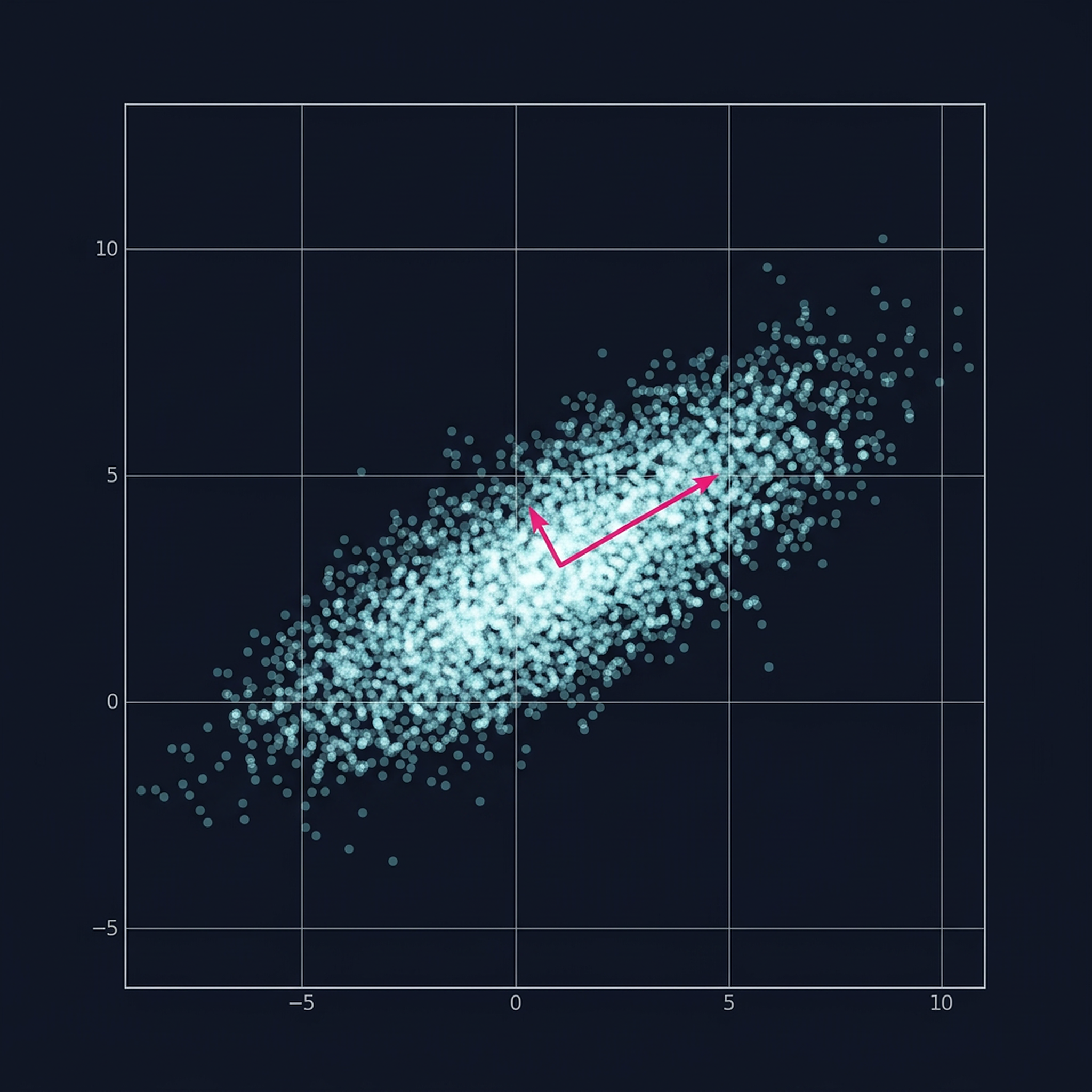
Rolling PCA on log returns extracts the common factors driving the universe, avoiding the beta≈1 bias of naive market-neutral strategies. Each stock's returns are projected onto the leading eigenvectors and regressed to produce a theoretical "fair value" return; deviations of actual from theoretical cumulative returns generate the mean-reversion signal.
The key lesson of the thesis is regime detection. The pure mean-reversion version lost about 30% in 2009 (Sharpe ≈ −1.85), run over during momentum periods. Adding an overlay that tracks the acceleration of cross-sectional factor dispersion — fading moves when dispersion contracts, following them when it expands — turned the same 2009 backtest to roughly +77% with Sharpe ≈ 7.7 and a 1.5% max drawdown.
The published results are an idealized single-year backtest without slippage or latency; treat them as a proof of concept whose regime-switching insight is the durable contribution.
References
- Infantino, L. R. & Itzhaki, S. (2010). "Developing High-Frequency Equities Trading Models." MBA thesis, MIT Sloan School of Management. https://dspace.mit.edu/handle/1721.1/59122