
Solving the "Corner Solution Problem" of Portfolio Optimization
Extreme concentration in efficient portfolios is structural, not estimation noise — so instead of fighting it with shrinkage, search a small tolerance neighbourhood of the frontier for the most diversified near-efficient portfolio.
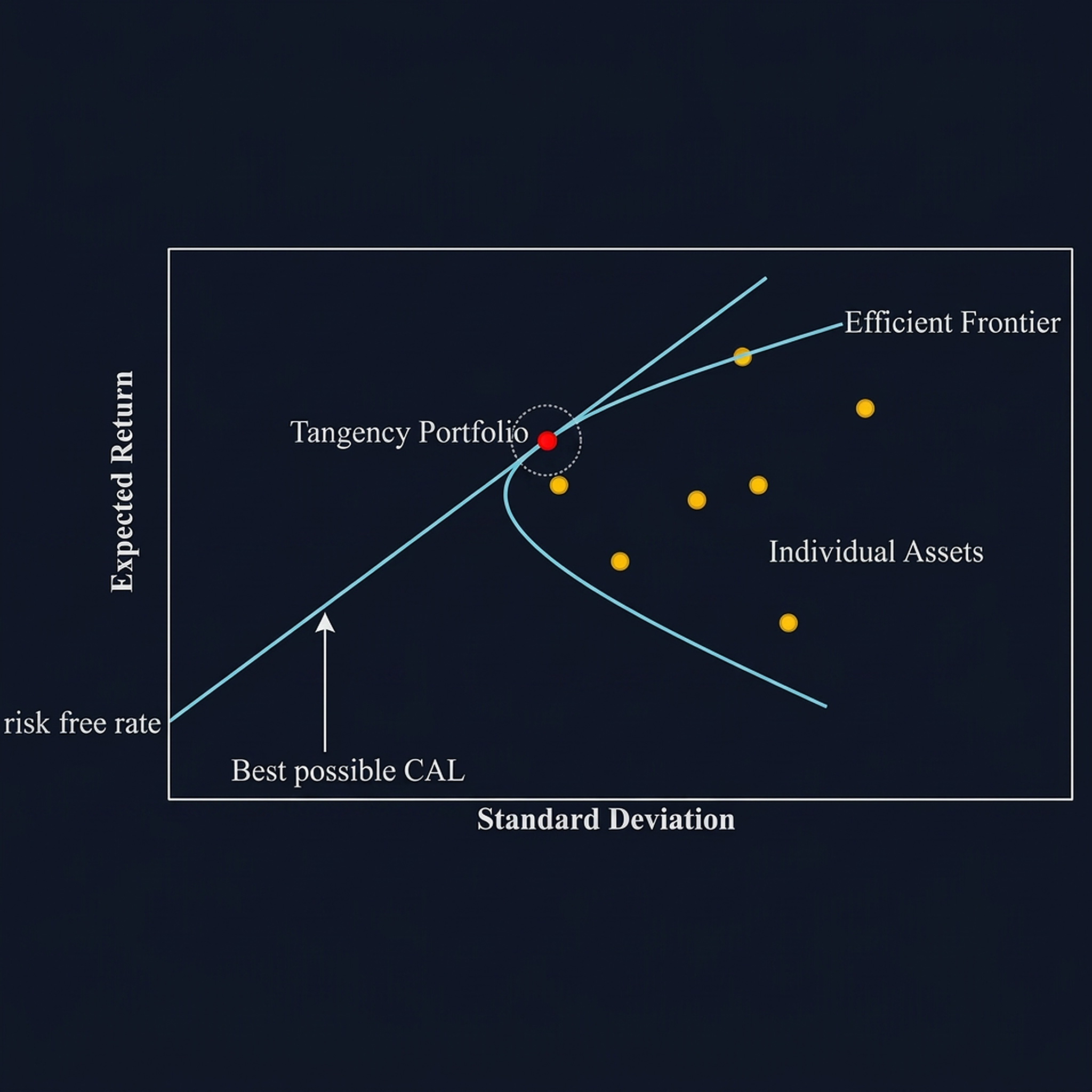
Green & Hollifield derive analytic conditions under which mean-variance-efficient portfolios must be well diversified, and show those conditions fail in practice because equity returns are dominated by a single common factor: hedging factor exposure requires extreme offsetting long-short positions, even though residual risk diversifies away easily.
Crucially, they show this concentration is a structural consequence of the factor structure — unlikely to be attributable to sampling error. Better estimation of means and covariances alone will not fix it.
This model takes the practical route: allow a tiny tolerance around the efficient frontier — say a one-hundredth neighbourhood — and there are thousands of near-efficient portfolios, many of them well diversified. The optimizer searches that neighbourhood for the most diversified one, giving up a sliver of theoretical efficiency for a portfolio an investor will actually hold.
References
- Green, R. C. & Hollifield, B. (1992). "When Will Mean-Variance Efficient Portfolios Be Well Diversified?" The Journal of Finance, 47(5), 1785–1809. https://onlinelibrary.wiley.com/doi/10.1111/j.1540-6261.1992.tb04683.x